or “Reason #154 to avoid Moscow”
Putsch – “a violent attempt to overthrow a government.” Oxford Language Dictionary
There are some things I simply do not like that other people seem ok with. I hesitate to even mention these things out loud because that always seems to obligate the Lord to put those exact things in His “To do” list for me (usually within the next 30 days).
For example, Mountains. I really hate them. Give me a big, wide-open prairie and I am at peace… serene, even. Put me in tall mountains and I start feeling boxed-in. Why anyone with the sense to count to ten would ever willingly visit a mountain is beyond me.
Another is cold. I hate cold. I shake, shiver and feel as if I am dying when Zoya puts the thermostat on 73. I love heat. I am perfectly fine at 110 degrees. You can even throw in 100% humidity. I will not complain. I was relatively comfortable picking peas and throwing hay bales in Alabama in July, but put me in Russia during the fall and I have the physical disposition of the legendary Jamaican Bob-sledding team.
The third thing in my “Reasons-why-the-Lord-can’t-come-back-soon-enough” List is cities. I have never liked a city. If you ever hear me say I like a certain city, that is simply a polite way of saying I hate it slightly less than fingernails on a chalkboard or listening to a liberal praise communism. The only good feeling I associate with cities is leaving them.
At the very top of my list of cities I do not like is Moscow. In the 90’s I had to go through Moscow a lot. It was the main train and flight hub for European Russia and to get to Central Asia you had to go through it. Moscow had five commercial Airports and four Train Stations. Part of the Lord’s plan for my spiritual growth was apparently the requirement that I always arrived at a train station or airport on one side of the city and always left from one on the exact geographically opposite side, usually 60 miles away.
In the fall of 1993 I boarded a train in Almaty for the four day trip to Moscow. Upon arrival at the Kazan Train Station in Moscow, I would hop on a bus to the metro station, then ride the metro to the center of Moscow, change to another metro line, take it to another metro station, hop another bus and finally arrive at the Riga Train station. I could there buy a ticket for the overnight train to Riga, Latvia, where my parents were.
A word about Russian trains in those days. Russians (as well as all formerly Soviet peoples) have strong fear of cold. They believe it causes all sorts of sicknesses. They are even afraid of a cool breeze. They will blame rheumatoid arthritis on leaving a window open in the spring. In the spirit of this national paranoia they superheat their train cars. I am generally ok with this, but in those days most people riding those trains had not been brought up with the commercial availability of deodorant. I am not blaming them, merely stating the fact. When you are in a small compartment for four days in 90+ degrees, it becomes noticeable. Kind of like a slap in the face.
You never knew who was going to be in the train compartment with you. You might spend four days with a sweet rural family or you might spend it with drug addicts. Whoever it was, you knew them very well by the end of the trip.
On this trip I had shared my compartment with, among others, an older gentleman who had brought with him a marinated slab of raw pork-belly to eat. This was a 3-4 pound chunk that was marinated with garlic in the Slavic manner and eaten uncooked with bread. He would slice off thick pieces and eat them with black bread. I have since come to enjoy eating fat but at that time it was still “unpleasant” for me.
In true Russian manner he graciously offered to share with me. I accepted (to not offend him) and choked down a piece as thick as my middle finger. My stomach, as it has done so many times, expressed its staunch disagreement with my conscience immediately. He then wrapped up the still enormous piece of meat and placed it under his bunk. He planned on this being his food for the whole four days. Within minutes the whole compartment smelled like what we had just eaten.
The heating system, which was on full-blast, blew hot air from under the bunks. That meat sat there for four days. Day one the compartment smelled like an abattoir. Day three smelled like an abattoir’s dumpster. Stepping into our compartment brought an immediate wave of nausea. “Iron-gut” Ivan just kept slicing off enormous pieces and munching on it several times a day, sweetly smiling and offering me a piece each time. He was a super nice guy, but I was having a hard time enjoying his company.
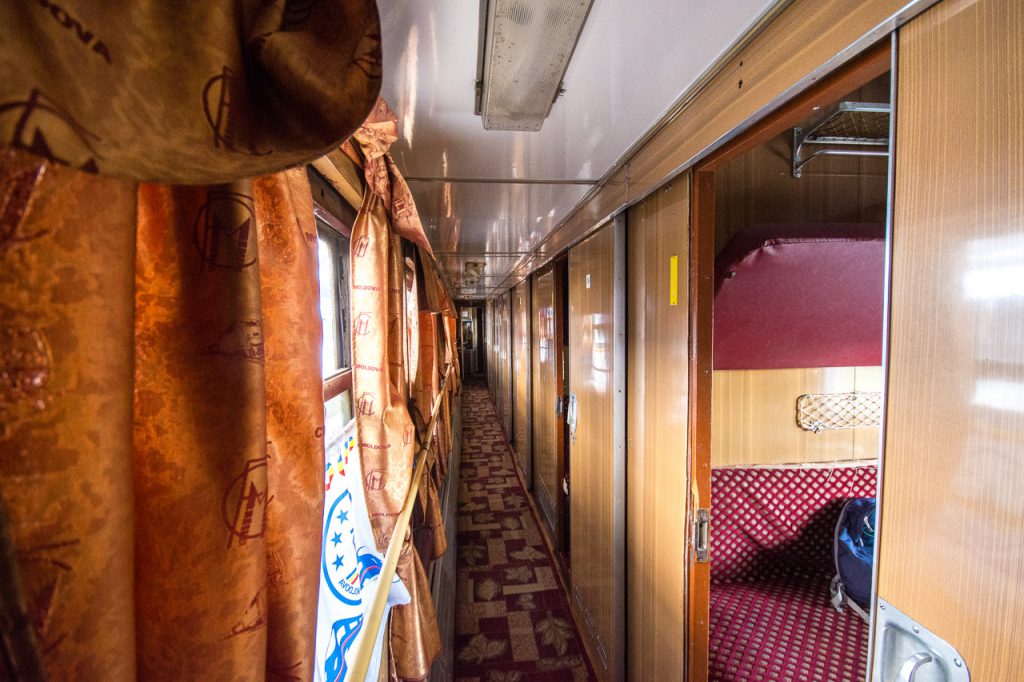
My choices of food were limited. At every stop Babushkas would come on board to sell food, but their offerings were deep-fried potato pies, smoked sardines, boiled eggs and black bread. I could only handle so many deep-fried pies before they got hard to keep down so my diet was mainly smoked sardines and boiled eggs. When I arrived in Moscow four days later, my stomach felt like I had drunk strychnine and I smelled like I had wallowed around in a Chinese landfill. This wasn’t conducive to lifting my mood about having to go through Moscow. The only bright spot being that I figured no one would interact with me inside a 15 foot smell-induced exclusion zone.
So I crankily exited the train in about as un-missionary a mood as was humanly possible (think Jonah chapter 4), staggered (with stomach cramps) onto a bus and rode to the metro station and took a subway to the center of Moscow. My plan was to go up to the surface and drop by the American Embassy in the heart of Moscow, add pages to my passport, then continue on the metro to the Riga Train Station.
I might also add that when I travelled, I wore one set of clothes and carried one other. I would wash one when it achieved intolerable-filth level and put on the other one. I travelled with one backpack which was mostly filled with books and space was at a premium. I washed clothes by hand in bathroom sinks usually. Well, I had recently been offered the use of a primitive washing machine. I had joyfully washed all my clothes together and, thanks to a bright red t-shirt, was now the proud owner of two sets of pink-tinted clothes. I turned heads wherever I went.
I exited the underground metro station (Krasnopresnenskaya) in the heart of Moscow and was immediately uneasy. There were no cars on the roads. The sidewalks were empty. Shops were closed. This was simply never the case in Moscow. It was always full of people. I wondered if it was a national holiday (the communists had a ton of them, like Patricia Lumumba’s birthday) or something. I just hoped the embassy was open.
The embassy sat uphill slightly from the Moscow River. I headed downhill towards the river, going down Konyushkovskaya street towards the embassy. On my right was a boulevard/Park and on my left a long line of buildings until you got to the embassy. Again, not a person was in sight. As I walked in my bad mood and stomach-upset haze, I noticed loud “BOOOM”s coming from somewhere up ahead. I disregarded it. It was Moscow, home of all sorts of ungodly and evil things…It could be anything. If Satan himself passed me on the sidewalk I would have considered it fitting. Did I mention that I didn’t like Moscow?
I passed the corner of a building on my left and into an intersection, only to be greeted by the sight of 15-20 Russian Policeman in full riot gear running full-speed right at me down the side street. They had on storm-trooper helmets, knee and elbow pads, metal shields and batons. When I say they were running, well, they were doing their dead-level best. They sounded like industrial machinery crushing rocks. I felt like a junior-varsity punt returner facing the Dallas Cowboys or whatever is worse than that.
A brief word about Russian Policemen. In those days the standard Russian policeman had the social demeanor of somewhere between a low-blood sugar gorilla and a rabid wolverine. This was combined with the morals of a pickpocket and the human empathy of a concentration camp guard. They were rough. One could easily get the impression that they got their job because trash-collecting was too intellectually challenging. Russian citizens often told me “Better to deal with criminals than the police.”
So there I stand, having walked out in front of them in a semi-dazed state, wearing my filthy, pink clothes and lugging a heavy back pack. I forgot about my stomach ache entirely and began the process of fainting from shock. Behind this platoon of Moscow’s finest a huge mob of people rounded the corner. They were carrying signs and banners and likewise running while yelling various uncharitable things at the cops. There looked to be hundreds of them. I could say that my life flashed in front of my eyes or that I tried to plot my escape, etc. The truth is, I froze. I went completely blank.
The first thought that came into my head was (since I gave Russian policeman about the same wide-berth as I would a gut-shot Grizzly): “Don’t Run! They will think you are guilty of something.” This was followed immediately by the thought: “Run from whatever made them run.” In retrospect that was the wiser course because it takes a lot to spook that many Russian riot Police. The general wisdom being: “If you see Russian police running from something, try to pass them.”
At first not a single muscle responded to my “let’s run” idea, but gradually the message arrived to my legs and I performed an expedited strategic withdrawal back around the corner I had just passed. I am surprised in retrospect that they did not pause a moment to consider the pink shrouded, throw-up scented apparition they passed at a dead-run but I guess they were too absorbed with survival. Anyway, they pounded past me without a glance and were then followed by the couple of hundred agitated Muscovites.
I am not the sharpest knife in the kitchen, but even I was beginning to catch on that something very unpleasant was happening in Moscow, or I should say something more unpleasant than was usually the case in Moscow, home of all things unpleasant. I decided that extra pages in my passport were not of life-or-death importance and therefore decided to head for the nearest metro station and depart Ninevah/Sodom post-haste.
The metro station I had arrived in was uphill. I thought there was another one downhill. Since my legs were still not responding well to my decisions due to shock (they felt like rubber-bungees) I opted to move unsteadily downhill. This eventually brought me out to a wide-open expanse where there was a bridge over the Moscow river and a huge highway interchange. You could see a mile across the river.
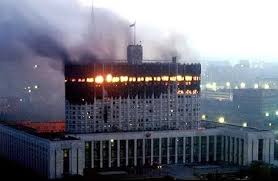
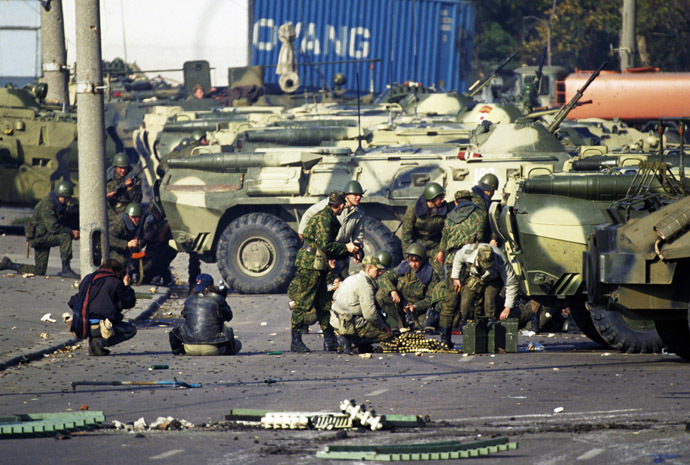
At this point I discovered the source of the loud BOOOOMs I had been hearing. As I rounded the last corner I was greeted with the sight of four Russian tanks (T-90s) in a line across the highway in front of me (about 600 feet). They had their guns aimed at the large white building to my right and were firing away, smoke rising from their barrels. it turned out that the enormous white building was the Russian White House, home of the Russian DUMA (Congress). Its upper floors were in flames, black smoke pouring out of every window. The only reason the tanks weren’t firing on the lower floors was that since the tanks were on an overpass, they could not depress their cannon barrels enough to fire down at the lower floors. To compensate they fired their entire ammo load as fast as they could reload at every window above the 10th floor. They were really doing a number on the building.
My legs suddenly decided they were willing to participate in their own survival and adrenaline flooded me. I double-timed back up the hill and hopped the metro, which was full of people acting as if it was a normal day.
I eventually got to the train station and later on the train and after about 36 hours was in Riga, Latvia where my parents were. I always like visiting them since I could sleep anxiety-free for a few days at least and gain some weight back from my mother’s biscuits and gravy. My mom could cook biscuits in the jungle (and actually had). There were few things more spiritually restorative than a pan of hot biscuits.
I eventually found out what had been happening in Moscow. It seems I had sleepily meandered into the “Constitutional Crisis” of 1993. By “Constitutional Crisis” they meant “Coup attempt.” The Russian parliament had tried to throw out Boris Yeltsin and he had convinced the army to support him. The tanks I had seen had been from the Elite 1st Guards Tank Army which had protected Moscow since World War 2, and does so to this day. The unfortunate occupants of the Russian White House who had been catching high-explosive rounds had been the senators who opposed Yeltsin. They had miscalculated. The key to a successful coup always being timing, President Yeltsin had, in the immortal words of Nathan Bedford Forrest, been able to: “…arrive fustest with the mostest.” The Coup was crushed and Yeltsin went on to serve for six more years.
At the time of the coup a young reserve KGB Lt. Colonel named Vladimir Putin was serving in the city administration of St. Petersburg and reportedly moonlighting as a taxi driver to make extra money. He would move to Moscow three years later and begin his meteoric rise to power, using his KGB training and connections.
Over a year later I was telling this story to a journalist for “Der Spiegel” magazine. He listened to this and a few other stories (like the time I spent two days with an arm’s dealer who, in addition to keeping me alive while I suffered from Basilic Dysentery, offered to sell me a MIG-29 Fighter for $20,000 “…It flies fine but has no guns…”) and asked me “Can I write your stories down?” I told him that was not possible for me since I did not need extra attention due to my work as a missionary. He gave me his card and asked if I would notify him if I could ever let him. I said sure and heard a few years later that he had been killed during a “robbery” in a hotel in Uzbekistan.
To say that God has always protected me is an understatement. I feel I serve partially as an object-lesson for other believers (as in, if He can protect me, He can protect anyone). There is also merit to the observation that special protective care is required for the mentally-disabled. It was once explained by a less-than-appreciative co-worker (after barely surviving one of my brilliant ideas) as “God loves even His dumbest children.”

